Spatial Technologist & Scenographer · MAS ETH DFAB Alumnus
Custom architectural curves are notoriously wasteful.
When an architectural competition scheme features sweeping, double-curved facade geometries, the fabrication reality behind the scenes is brutal. Contractors mill hundreds of giant EPS foam blocks or CNC-cut timber ribs to cast single-use molds. Once the composite panels cure, those molds go straight into commercial dumpsters.
During my Master of Advanced Studies at ETH Zurich (MAS ETH DFAB), our research focused on an alternative: zero-mold additive manufacturing.
If a six-axis industrial robot can deposit structural polymer along three-dimensional spatial curves, single-use formwork disappears.
| Fabrication Method | Formwork Waste | Structural Performance | Geometric Freedom |
| :--- | :--- | :--- | :--- |
| CNC Foam Milling | 100% disposed after casting | High (cast concrete / composite) | High, but cost scales with every unique panel |
| Planar 3D Printing | Zero formwork | Weak delamination along layer seams | Limited to 2.5D slicing; staircase stepping |
| Non-Planar Robotic Printing | Zero formwork | High (beads follow stress vector lines) | Full 6-axis double-curved spatial trajectories |
| SMA Kinetic Skins | Zero motor gearboxes | High resilience (passive crystal phase shift) | Thermo-responsive self-shading origami folds |
Moving beyond flat slicing
Standard desktop 3D printing slices geometry into flat horizontal layers. That works for paperweights, but it fails for architectural envelopes.
Flat horizontal slicing creates staircase stepping along steep curvature. More importantly, layer adhesion becomes a structural weakness. Wind suction on a building facade will rip flat layer seams apart.
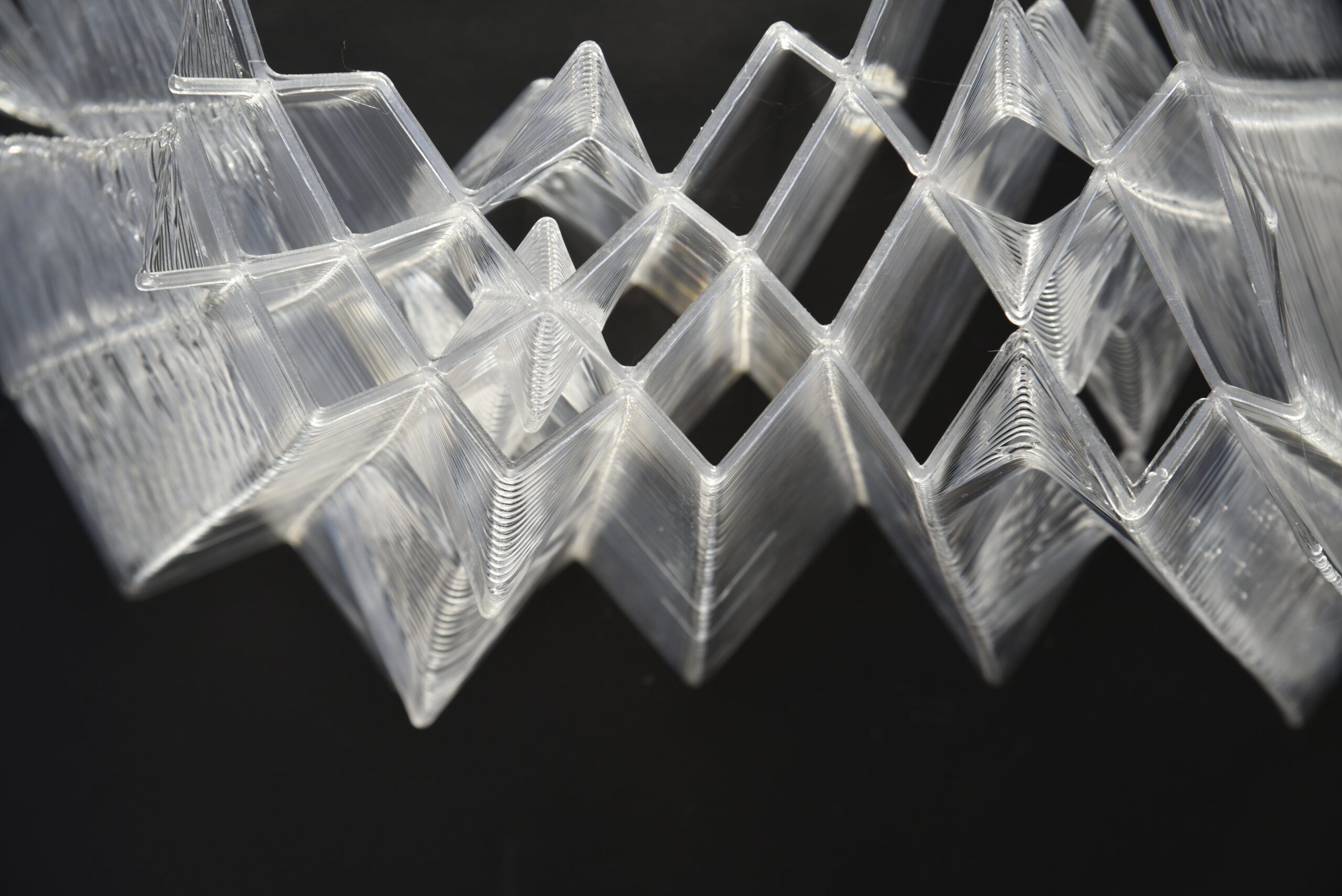
We developed custom non-planar slicers using Rhino, Grasshopper, Python, and C#. Instead of slicing flat planes, our algorithms generated toolpaths directly onto doubly-curved parametric surfaces. The industrial robot arm rotated its extrusion nozzle normal to the surface tangent at every millisecond.
The extruded composite ribs followed internal structural load vectors. We placed thicker bead lines precisely where wind shear peaked, and thinned the toolpaths where the panel needed natural daylight diffusion.
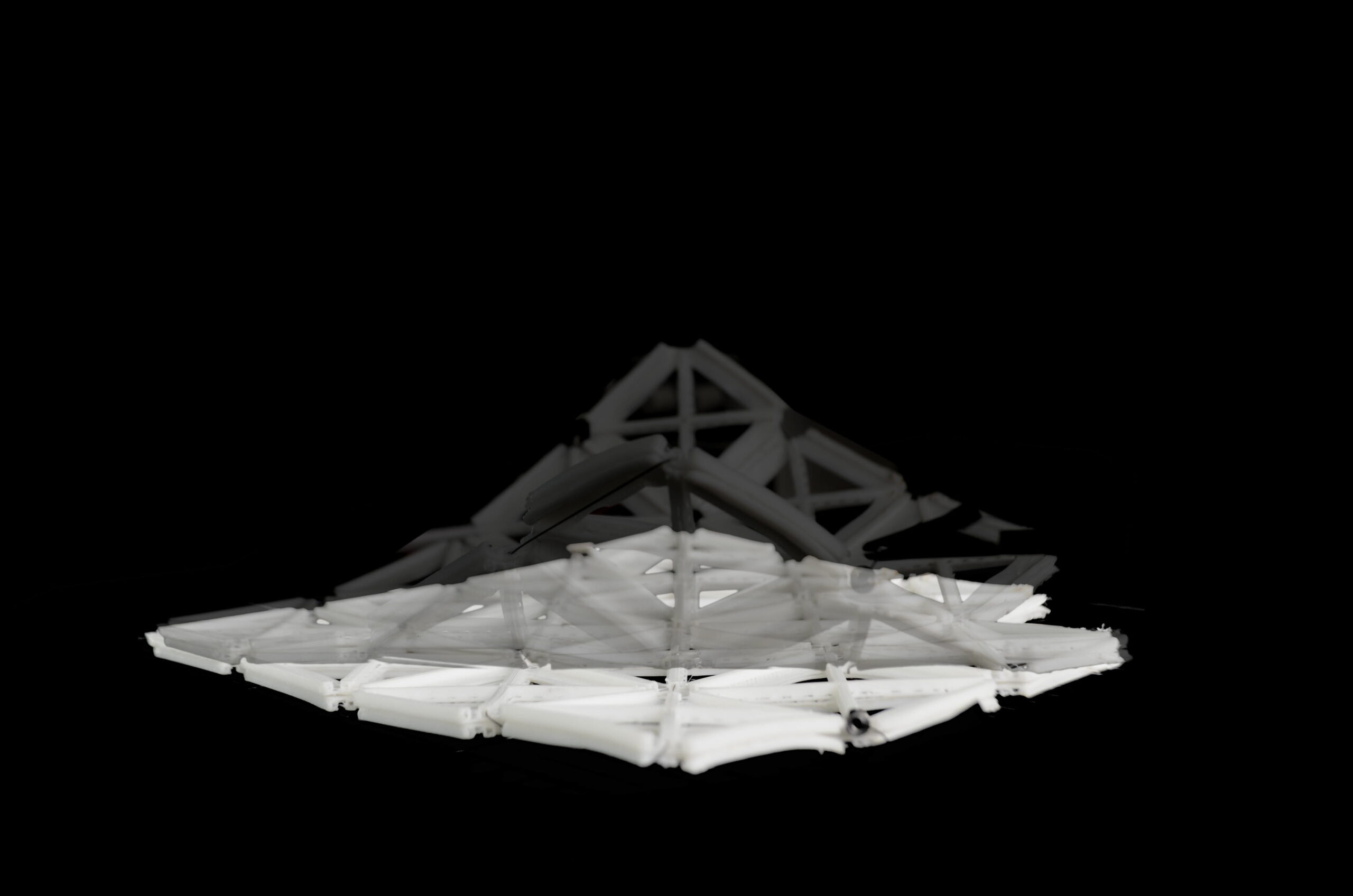
Thermo-responsive kinetic facade prototype with shape memory alloy actuators
Kinetic facades without electric motors
Robotic fabrication solves the production side of envelopes. Material computation solves the operational side.
Mechanical motors inside exterior facades break. Dust infiltrates gearing, grease dries under direct sunlight, and maintenance technicians cannot safely climb forty-story towers every six months to swap stepper units.
In our kinetic architecture research, we turned to shape memory alloys (SMA).
Shape memory alloys (such as nickel-titanium Nitinol) shift crystal phase at specific thermal thresholds. When sunlight heats the exterior building skin past 32 degrees Celsius, the alloy wire contracts with immense force, pulling folded facade origami louvers open to shade the glass. As twilight cools the facade, the alloy relaxes and the louvers spring closed.
Zero motors. Zero gears. Zero noise. The material itself acts as sensor, actuator, and processor simultaneously.
"When you replace disposable molds with robotic precision and responsive materials, architecture leaves behind the era of mass replication."
Precision glass forming with robotics
We carried that philosophy forward into the Beyond Transparency glass research pavilion with Swiss Re.
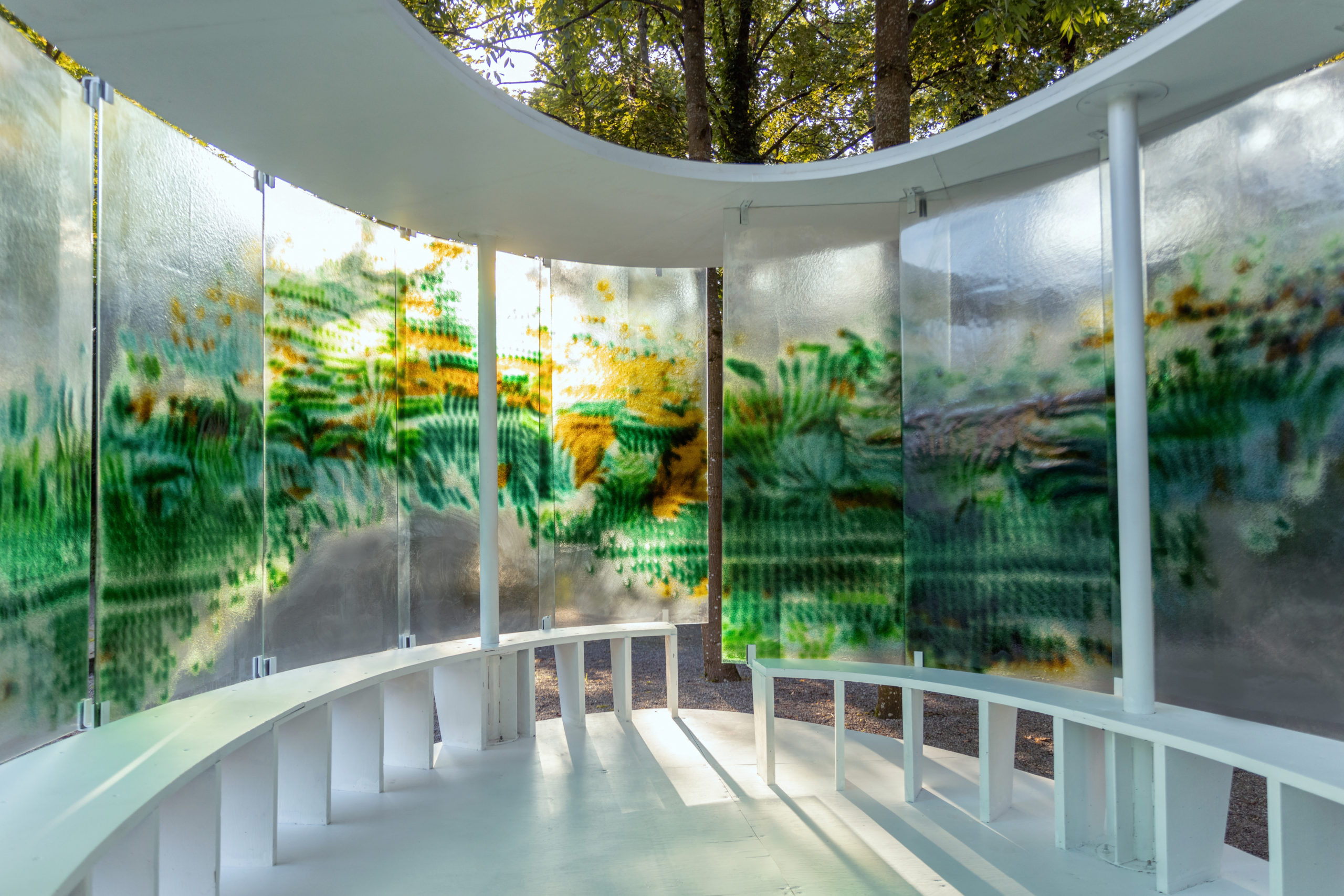
Rather than relying on steel molds to shape curved structural glass panels, an ABB industrial robot dispensed colored mineral frit onto flat float glass before thermoforming in a custom programmable kiln.
Robotic glass pavilion exterior with custom structural geometry at Swiss Re
The computational designer's toolkit
Building at this frontier requires mastering both algorithmic logic and factory floor safety:
Robotic kinematics: KUKA KRL, ABB RAPID, and custom Grasshopper toolpath generators to prevent axis singularities.
Parametric geometry: Curvature analysis, mesh discretization, and unrolling algorithms in Rhino Grasshopper.
Material testing: Tensile load verification on physical specimens before specifying full-scale panels on real construction sites.
When you replace disposable molds with robotic precision and responsive materials, architecture leaves behind the era of mass replication. Buildings become custom, efficient, and light.
Frequently Asked Questions
What is non-planar robotic 3D printing in architecture?↓
Traditional 3D printers slice digital models into flat horizontal 2D planes. Non-planar robotic toolpathing uses 6-axis industrial robotic arms to deposit material along double-curved spatial trajectories, aligning polymer fibers with architectural stress lines and eliminating staircase stepping artifacts.
How do shape memory alloy (SMA) building skins work?↓
Shape memory alloys (such as nickel-titanium Nitinol) change crystal structure when heated by ambient sunlight or electrical current. When woven into facade panels, they contract to open solar louvers passively without noisy electric gear motors.
How does robotic digital fabrication cut architectural construction waste?↓
Bespoke curved architectural facades typically require expensive single-use EPS foam or timber molds that end up in landfills. Direct robotic extrusion manufactures custom building panels additively without formwork, using recyclable composite polymers.