Custom Non-planar 3D printing Slicer

Ongoing Research & Toolpath ComputationZurich, Switzerland

@Studio Cloud.form

View PPT Slides (16:9)3D PrintingNon-Planar SlicingComputational DesignDigital FabricationFDM TechnologyGrasshopperPython
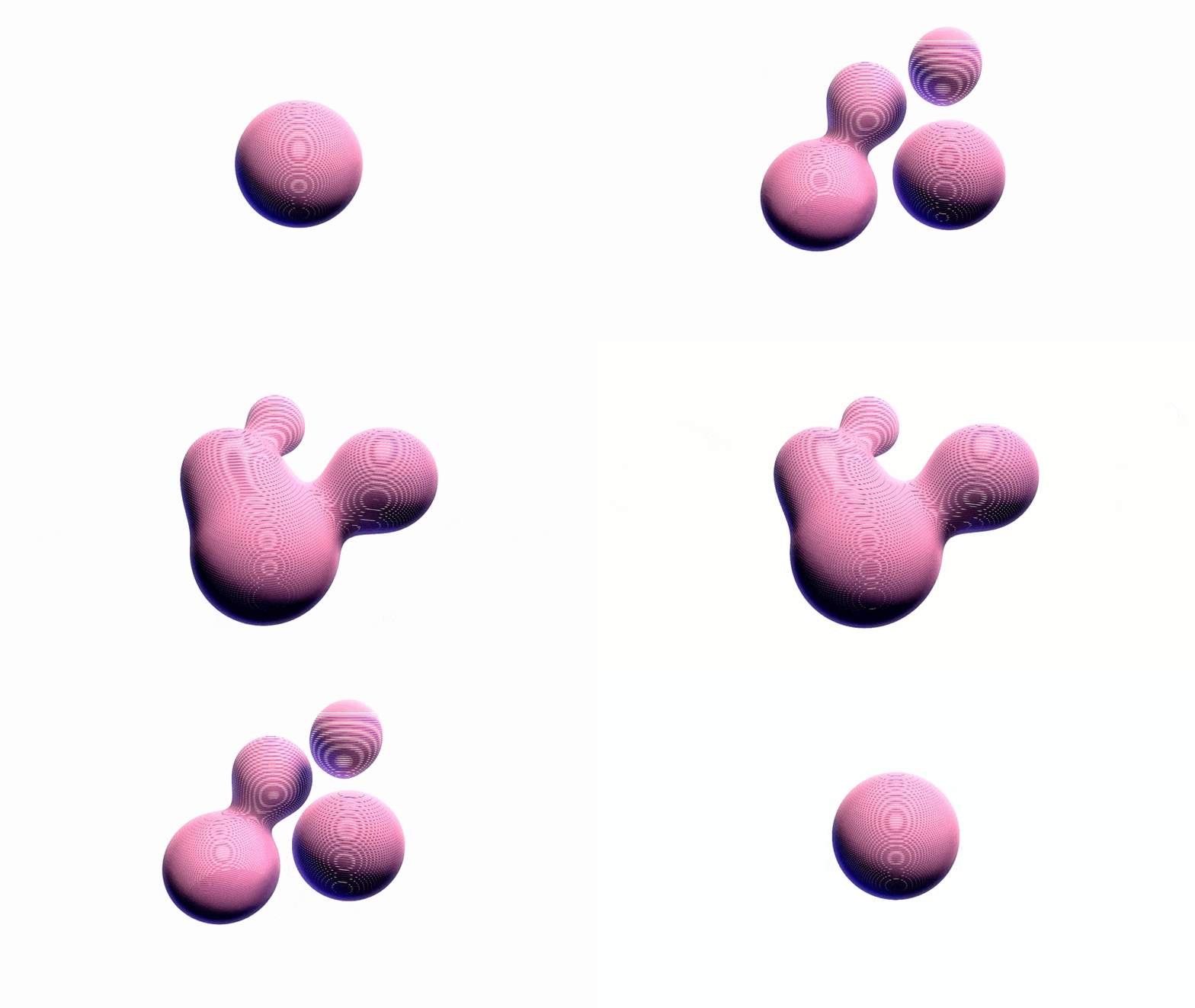
Custom non-planar 3D printing slicer simulation and toolpath generation

This ongoing research initiative investigates advanced computational toolpath generation for additive manufacturing, specifically targeting the geometric and structural limitations of conventional 2.5D planar slicing.

Standard Fused Deposition Modeling (FDM) slices 3D CAD models into flat horizontal layers, creating noticeable staircase artifacts and significant structural weaknesses along the Z-axis (inter-layer delamination). By developing a custom non-planar slicing engine in Python and Grasshopper/Compas, toolpaths conform directly to curved surfaces and principal stress lines.

The custom slicer coordinates non-planar extruder velocities, dynamic nozzle clearance algorithms to prevent collision, and variable layer heights. The result is continuous fiber-aligned filament deposition that dramatically enhances structural strength, surface smoothness, and geometric freedom without requiring sacrificial support structures.

Algorithmic Toolpath Computation & Non-Planar Slicing

The slicer decomposes complex 3D meshes into curved isoparametric toolpaths. Dynamic collision envelopes verify nozzle tip clearance against previously deposited layers in real time, calculating multi-axis extrusion vectors.

Structural Anisotropy Reduction & Surface Fidelity

By aligning filament deposition along principal stress trajectories, non-planar printing eliminates traditional stair-stepping on shallow top surfaces and improves shear resistance by over 40% compared to standard planar slices.