Physical AI in Architecture and Spatial Design
From diffusion renders to robotic toolpaths, real-time sensing, and built envelopes
Spatial Technologist & Scenographer · MAS ETH DFAB Alumnus
Most discussions about artificial intelligence in architecture stop at text-to-image prompts. Designers type adjectives into Midjourney or Stable Diffusion, watch four synthetic images appear on screen, and mistake bitmap generation for architectural design.
Architecture does not exist as RGB pixels. Built space consists of compressive strengths, thermal tolerances, metric coordinates, and structural joints. When machine learning stays confined to 2D image generators, it provides no structural understanding, no toolpath data, and zero spatial actuation.
Physical AI shifts the computational focus from pixel grids to physical matter. It couples neural networks with 3D spatial vision, 6-axis robotic arms, embedded sensor networks, and real-time environmental computation.
| Dimension | 2D Generative AI (Diffusion) | Physical AI (Spatial Architecture) | | :--- | :--- | :--- | | Output Data | 2D raster bitmap (PNG/JPEG) | 6-DOF robotic toolpaths, G-code, parametric meshes | | Spatial Grounding | Imagined perspectives with zero scale | Millimeter-accurate LiDAR point clouds and metric coordinates | | Material Feedback | Visual texture simulation | Slump measurement, shear resistance, cure times | | Compute Engine | Cloud diffusion servers | Local real-time nodes (C++, Python, ROS 2, Grasshopper) | | Spatial Actuation | Screen display | Industrial robots (KUKA, UR10), microcontrollers (ESP32) |
Neural toolpath planning for robotic fabrication
Digital fabrication frequently breaks down during the slicing phase. Traditional planar slicing cuts complex 3D geometry into flat horizontal layers. For doubly curved architectural elements, horizontal slicing creates stair-stepping weaknesses and demands massive temporary support scaffolds that end up in landfills.
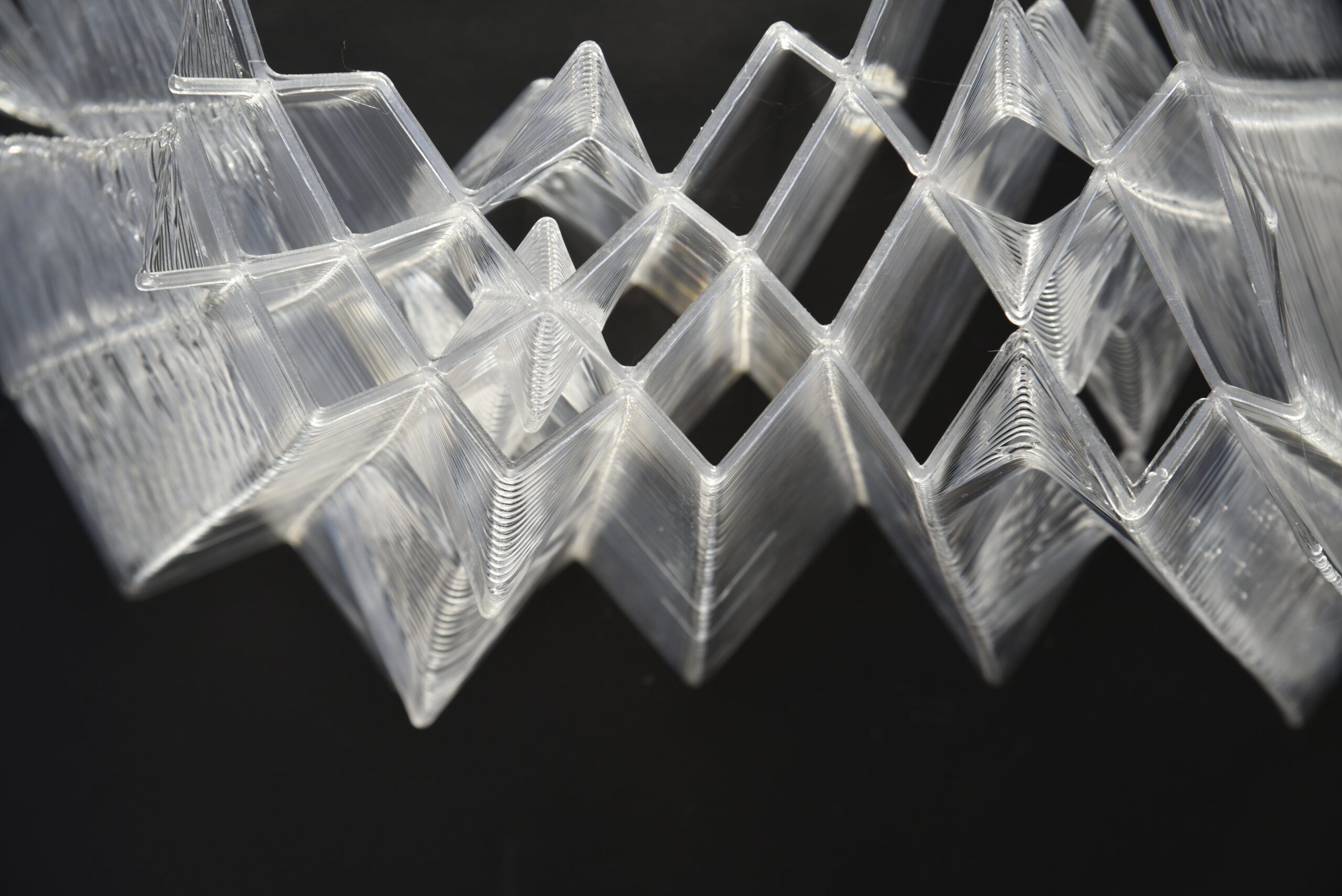
In our robotic 3D printing research for composite facades at ETH Zurich, we developed non-planar slicing algorithms running on 6-axis robotic arms. Using machine learning models trained on structural stress fields, we oriented printing layers along principal stress trajectories rather than flat horizontal planes.
Instead of uniform layer deposition, neural networks analyzed geometric cantilevers and calculated extrusion slump before the polymer cooled. If an overhang exceeded 45 degrees, the slicer algorithm altered nozzle speed and cooling airflow in real time.
The outcome eliminated single-use molds. By combining parametric geometry in Rhino and Grasshopper with forward toolpath correction, we printed freeform structural facade components with sub-millimeter tolerances.
Closed-loop kinetic skins and thermal actuation
Beyond additive manufacturing, physical AI controls how materials respond to thermal gradients in physical space. Rather than relying on motorized mechanical louvers that break down after continuous operation, architectural envelopes can achieve kinetic movement through material programming.
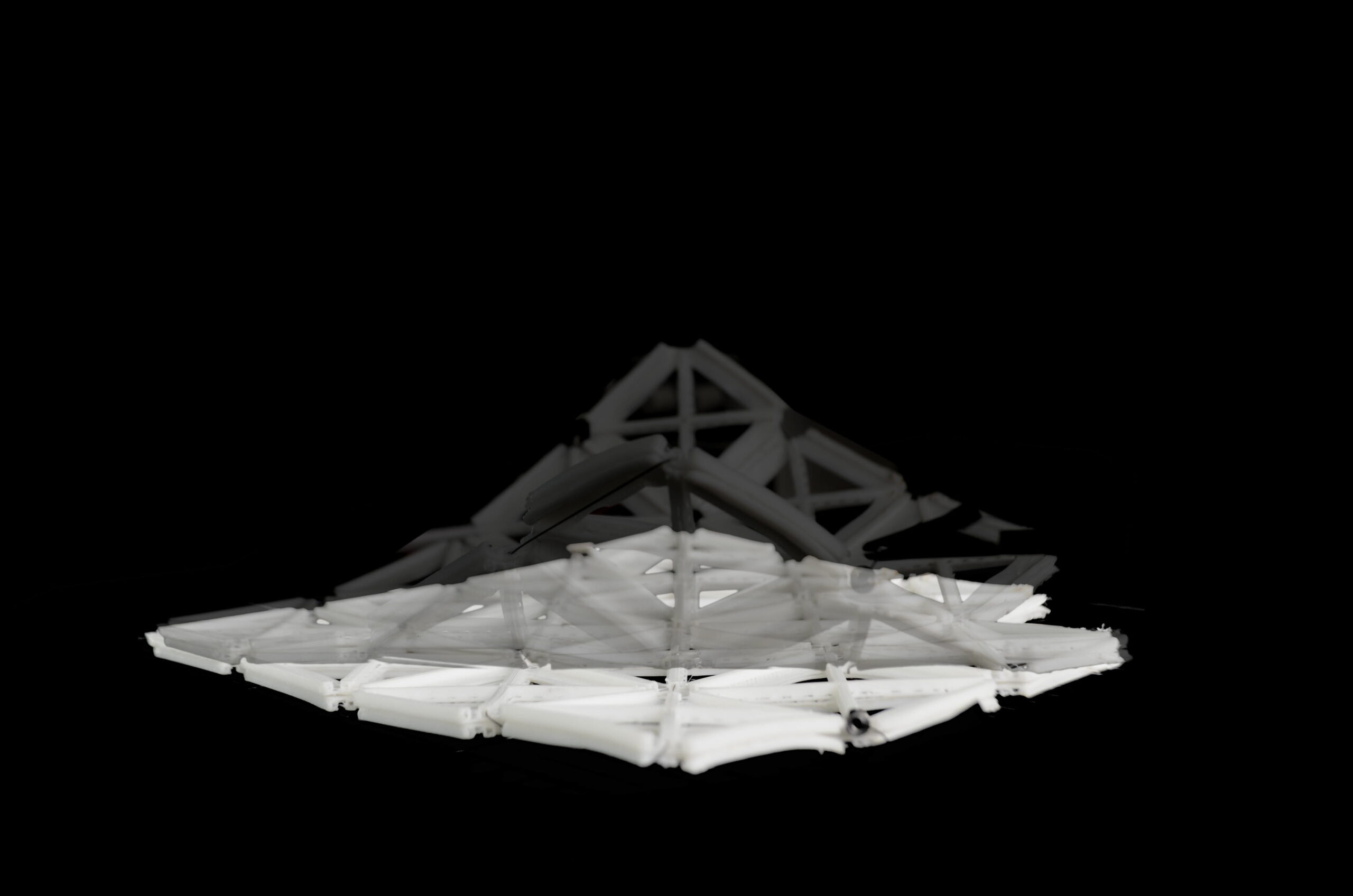
In our work on kinetic architecture with shape memory alloys at ETH Zurich, we engineered responsive facade elements combining multi-material 3D printed polymers with nickel-titanium wires. When exposed to solar radiation or controlled current pulses, the alloy contracts along calibrated transformation paths.
Machine learning models simulate the hysteresis curves of the nitinol wire arrays. By pairing continuous thermal sensing with algorithmic pulse controllers, the skin opens and closes facade apertures without mechanical gearboxes. The envelope breathes autonomously based on measured microclimate conditions.
Real-time spatial intelligence in built institutions
Beyond fabrication labs, physical AI governs how public and cultural institutions react to human presence. At the Museum of the Future in Dubai, scenographic environments require responsiveness without forcing visitors to handle physical controllers or stare at personal phone screens.
Embedding spatial intelligence into architectural interiors requires an array of non-intrusive sensors:
- Millimeter-Wave Radar: Micro-radar sensors track human proximity, vector velocity, and breathing cycles without collecting facial images or private personal data.
- Real-Time Spatial Point Clouds: Overhead LiDAR scanners generate real-time depth meshes of visitors moving across public plazas and exhibition halls.
- Low-Latency Edge Compute: Local workstation clusters process visitor position data and output OSC and Art-Net packets over Gigabit Ethernet in under 20 milliseconds.
When a visitor walks toward a kinetic wall module or generative projection surface, the room responds to their movement velocity and dwell duration. The space functions as an active participant rather than a passive container of furniture.

The physical AI stack for spatial technologists
For computational designers and spatial technologists engineering live physical environments, the production stack connects three distinct tiers:
- Perception Layer: Ouster LiDAR units, mmWave radar transceivers, 6-axis IMU sensors, and calibrated Intel RealSense depth cameras.
- Compute and Inference Engine: NVIDIA Jetson Orin edge nodes running custom PyTorch models, ROS 2 nodes, and Python scripts within Rhino Grasshopper.
- Actuation and Display: Beckhoff PLCs, KUKA and Universal Robots industrial arms, ESP32 microcontrollers, Art-Net DMX nodes, and Unreal Engine 5 render clusters.
Architecture will not be transformed by text prompts that generate fantasy concept art. The real progress belongs to spatial practitioners who take machine intelligence out of the 2D web browser and anchor it into structural steel, responsive mechanisms, and physical building envelopes.
Frequently Asked Questions
What is physical AI in architectural design?↓
Physical AI describes machine intelligence embedded into physical systems, industrial manipulators, and architectural sensors. Rather than producing 2D image renders, physical AI models compute spatial kinematics, real-time toolpaths, and responsive structural changes.
How do architects use machine learning for robotic fabrication?↓
Teams feed real-time depth sensor data into neural networks to modify robotic toolpaths during operation. This enables 6-axis arms like KUKA or Universal Robots to extrude continuous non-planar 3D printed toolpaths with sub-millimeter precision.
Why do 2D diffusion models fall short in architectural practice?↓
Diffusion models generate pixel patterns without structural comprehension, material physics, or spatial coordinates. Real architectural engineering demands deterministic geometry, structural finite element analysis, and direct robotic actuation.
Referenced Case Studies & Installations
Robotic 3D-Printing for Composite Facades
ETH Zurich MAS DFAB Research
Kinetic Architecture with 3DP & Shape Memory Alloys
MAS THESIS RESEARCH - RIGIDITY, FLEXIBILITY, AND ACTUATION
Museum of the Future, Dubai
Level 5: Orbital Space Station H.O.P.E.